
List of Chemicals Used in Oil and Gas Industry

The oil and gas industry relies on various chemicals across drilling, production, processing, and transportation to ensure efficient operations and maintain safety. This article provides a practical, operator-focused list of key chemicals, their functions and selection considerations for operations teams, procurement, and supply chain managers.
TL;DR – Summary
- The oil and gas industry uses specialized chemicals at every stage.
- The most critical categories are corrosion inhibitors, scale inhibitors, demulsifiers, surfactants, biocides, H₂S scavengers, paraffin inhibitors, drilling fluid additives (e.g., soda ash), hydrate inhibitors (e.g., ethylene glycol), and EOR chemicals.
- Each plays a vital role in ensuring safety, maintaining flow, protecting equipment, and optimizing operational efficiency.
Why Chemicals Are Vital in the Oil and Gas Industry
Various chemicals enable efficient operations across drilling, oil and gas production, gas exploration, and refining. During extraction, specialized drilling fluids stabilize the wellbore under high pressure, while production chemicals maintain the flow of crude oil and natural gas through pipelines and processing facilities. Without these chemical interventions, equipment degradation would accelerate and safety risks would multiply. These chemicals enhance efficiency, ensure safety, and improve the quality of final crude oil and natural gas products.
The global specialty oilfield chemicals market is projected to grow from USD 16.75 billion in 2025 to USD 19.69 billion by 2030. Different chemical compounds are tailored to upstream (exploration and drilling), midstream (transportation), and downstream (refining) stages.
How This List Helps Operators, Engineers, and Buyers
This list is organized by problem: corrosion, scale, flow assurance, microbial growth, toxic gas control so readers can quickly match issues to chemical solutions. It covers applications in pipelines, drilling fluids, drilling mud, storage tanks, produced water, gas wells, and refineries.
Beyond generic lists, this guide includes logistics and shipping considerations, since many oil and gas chemicals are classified as hazardous materials requiring strict adherence to safety regulations during transport.
Major Categories of Chemicals Used in Oil and Gas Operations
Major categories include corrosion inhibitors, scale inhibitors, demulsifiers, surfactants, biocides, H₂S scavengers, paraffin inhibitors, drilling-fluid additives, gelling agents, hydrate inhibitors, and enhanced oil recovery (EOR) chemicals.
Drilling operations use drilling fluids and mud additives for wellbore stability. Production relies on corrosion and scale inhibitors to maintain flow. Gas exploration uses hydrate inhibitors like ethylene glycol. Refining and produced water treatment use demulsifiers and biocides. Common bulk chemicals such as sodium carbonate (soda ash) feature prominently across these stages.
Core List of Chemicals Used in the Oil and Gas Industry
Below is a practical list of the most important chemical groups with their functions and applications.
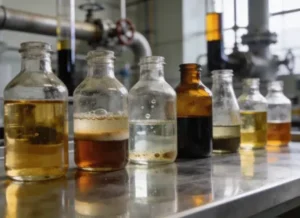
1. Corrosion Inhibitors
Corrosion inhibitors protect metal surfaces in pipelines, drilling equipment, and storage tanks from corrosion caused by water, hydrogen sulfide, carbon dioxide, and other agents. They form an adhesive protective coating on metal surfaces, preventing corrosion and extending asset life.
Common application points include oil and gas wells, flowlines, gas pipelines, storage tanks, produced water systems, and refining units. Inhibitors are deployed through both continuous injection and batch treatments to prevent corrosion and protect equipment, extending the operational lifespan of metal components across the entire production process.
2. Scale Inhibitors
Scale inhibitors prevent the formation of mineral deposits such as calcium carbonate and barium sulfate in pipelines, equipment, and reservoirs. They interfere with crystallization, ensuring smooth operation and maintaining flow. Used in produced water, injection water, downhole squeeze treatments, and heat-exchange surfaces to prevent buildup that would otherwise restrict flow and damage equipment.
3. Demulsifiers
Demulsifiers break stable oil-water emulsions so crude oil meets pipeline and refinery quality standards. Used at production separators, gathering systems, and storage tanks, they reduce downstream corrosion and fouling by removing produced water from crude oil during the production process.
While demulsifiers share some properties with surfactants, their primary goal is separation rather than improved flow through rock formations. They are essential wherever water-in-oil or oil-in-water emulsions form during the production process.
4. Surfactants and Wetting Agents
Surfactants reduce surface tension between fluids and rock formations, aiding in the removal of oil and gas from rock and enhancing production efficiency. Used in drilling fluids, hydraulic fracturing, enhanced oil recovery, and equipment cleaning. In EOR and hydraulic fracturing, they mobilize trapped oil and improve sweep efficiency.
5. Biocides
Biocides control the growth of harmful microorganisms in water systems, pipelines, and oil reservoirs, preventing biofouling and microbiologically influenced corrosion. They address reservoir souring, plugging, and slime formation.
Widely used in produced water treatment, water injection systems, and storage tanks to maintain water quality and ensure safety. They are generally categorized into short-contact kill biocides for rapid microbial knockdown and longer-term continuous-dose biocides for ongoing control.
6. Hydrogen Sulfide (H₂S) Scavengers
H₂S scavengers remove hydrogen sulfide from crude oil, natural gas, and refining streams, ensuring safety and product quality. H₂S is both toxic and corrosive; scavengers neutralize it into less harmful compounds.
Common scavenger families include triazines and glyoxal-based formulations, used in gas sweetening, production fluids conditioning, and midstream treatments in gas wells and gas production facilities. Their application is essential for meeting pipeline quality specifications and regulatory safety standards.
7. Paraffin and Asphaltene Inhibitors
Paraffin inhibitors prevent wax deposition in pipelines and production equipment, maintaining flow and operational efficiency. They modify crystal formation to keep crude oil flowing, particularly in colder conditions. Some formulations combine inhibitors with solvents for heavy organic cleanup.
8. Drilling Fluids and Drilling Mud Additives
Drilling fluids (drilling mud) contain viscosifiers, fluid-loss additives, shale stabilizers, lubricants, and pH control agents. They cool the drill bit, regulate pressure, and prevent intrusion of unwanted substances. Sodium carbonate (soda ash) is a key stabilizing agent for treating calcium contamination and adjusting pH during drilling operations.
9. Polymers
Polymers, including guar gum and synthetic variants, serve multiple roles across oilfield operations. In hydraulic fracturing, they act as gelling agents, thickening the fluid enough to carry proppant into fractures. In slickwater treatments, the same or similar polymers work as friction reducers, cutting pumping pressure by smoothing turbulent flow. Cementing operations also rely on polymers as dispersants, fluid loss control additives, and viscosity modifiers to keep the slurry stable and pumpable downhole.
10. Foamers and defoamers
Foaming agents generate stable foam for underbalanced drilling and gas-well deliquification, lifting liquids from the wellbore when reservoir pressure alone can’t do the job. Defoamers do the opposite, collapsing unwanted foam in separators, treaters, and other surface equipment so that oil, gas, and water can be properly separated. Getting the balance right between the two keeps production steady and surface facilities running without interruption.
11. Hydrate Inhibitors and Ethylene Glycol
Hydrate inhibitors prevent gas hydrates from forming in wet gas lines at high pressure and low temperatures. Ethylene glycol (MEG) is the primary thermodynamic hydrate inhibitor, commonly injected and regenerated. Critical in gas industry operations during transportation and processing of natural gas. Alternative low-dosage hydrate inhibitors (LDHIs) offer additional options for operators seeking to reduce chemical volumes.
12. Enhanced Oil Recovery (EOR) Chemicals
EOR chemicals polymers, surfactants, and alkalis improve sweep and displacement efficiency for extracting oil from mature reservoirs. Polymer floods increase water viscosity, while alkaline-surfactant-polymer (ASP) systems maximize recovery. Selection depends on reservoir salinity, temperature, and crude oil composition. They are commonly deployed after primary and secondary waterflooding to maximize recovery from aging fields.
Shipping and Logistics Challenges for Oil and Gas Chemicals
Shipping oil and gas chemicals is complex: many are hazardous materials requiring strict regulations, proper labeling, and experienced carriers. Challenges include remote drilling site locations, supply chain delays, temperature-sensitive products, and the need for carriers who understand HAZMAT rules. Unreliable logistics companies can negatively impact operations at drilling sites, leading to downtime and financial losses. Proper packaging and labeling are essential to ensure safety during every stage of transport.
Working with specialized chemical logistics providers such as Sunita Hydrocolloids improves uptime, compliance, and overall efficiency.
How to Choose the Right Chemical Supplier and Logistics Partner
Key criteria for selecting the right partner:
- Technical support: Laboratory testing, field trials, and ongoing optimization of chemical programs.
- Industry experience: Proven track record across drilling, production, and refining environments.
- Supply chain resilience: Consistent supply to remote drilling sites with contingency plans.
- HAZMAT logistics: Experienced handling, transporting and documenting hazardous oilfield chemicals.
Look for partners who can tailor chemical programs with custom formulations and optimized dosing, validate performance through corrosion coupons and production KPIs, and align with your environmental and safety standards.
Contact Sunita Hydrocolloids for a comprehensive evaluation of your current chemical programs, benchmarking against best-practice formulations, and strategies for improving operational efficiency across your oil and gas operations.
Talk to Our Chemical Specialists – Contact Sunita Hydrocolloids